
Difference Between a Performance Max Campaign and a Search Campaign in Google Ads
If you’re working in digital marketing, especially in pay-per-click (PPC) advertising methods with Google Ads or Microsoft Ads, you’ve likely experienced these two types of campaign: Search Campaigns and Performance Max (PMax) Campaigns. Understanding how they work their differences, when to use them, and how they can complement one another is crucial to maximizing results and optimizing your performance. In this post, we’ll cover common questions marketers have, break down the key differences, show when a search or PMax campaign might be better than the other, and provide best practice recommendations.
What is a Search Campaign?
The Search campaign is the most common type of campaign in Google Ads or Microsoft Ads; it is the “classic” campaign we’ve known for decades. The primary feature and benefit is that we will utilize keywords to target our potential audience. We can use negative keywords, adjust bidding strategies, and have better control over the text ads. For instance, when a user types a query in Google Search (or its partner search network) that's relevant to your keywords, then your ads may appear. Therefore, you control which keywords to target, what ad copy is most aligned with your service or product, what landing page you want to use, what bid strategy is best suited for your goal, and often, which audience segments.
Main key characteristics:
Based on your keyword search, you select keywords that can be long-tail or short-tail terms. Additionally, depending on your strategy, you can use broad match, phrase match, or exact match to refine performance.
Once you know your goals, you can define and create the ad copy, which in a search campaign will consist of headlines (Max 30 characters) and descriptions (Max 90 characters).
You control bids, budgets, but a key difference compared to PMax is that you can also control device bid adjustments, location bids, and often audience targeting. This makes the Search campaign more controllable.
Generally, Ads show when users are actively searching: high–intent traffic. This means that when a user is actively searching for specific topics on Google Search, this is where search ads are likely to appear.
You can see which keyword is performing well, which term uses the most budget, and which keywords are driving high conversions or are underperforming. This is probably one of the most important features of search campaings, while PMax will not show such data.
Due to the fact that we target specific keywords in a search campaign, there is a high probability that many of those keywords perform slowly. Therefore, you can remove and add new terms based on performance.
You can add images; however, those images must be simple, meaning they should not contain text, otherwise, this could become ineligible.
The search campaign will only serve in the search channel across all Google channels. This could somehow limit the reach, but they are usually the most efficient ads.
What is a Performance Max (PMax) Campaign?
Performance Max Campaign is a relatively new campaign type in Google Ads that utilizes automation and Google’s machine learning to find a more relevant audience based on your target segmentation. It places different ad types across all Google networks from a single campaign, which is one of its key benefits. These include: Search, Display, YouTube, Gmail, Discover, Maps, and Shopping inventory (when you have products).
Main key characteristics:
You provide “assets” such as headlines, descriptions, images, videos, and logos. With those assets, Google dynamically displays them when it believes it will be more suitable to help achieve your goal. This makes the PMax very attractive since you can add different creatives.
Similar to a search campaign, you set a campaign objective (e.g., conversions or conversion value).
You can target “keywords” as search themes; however, in PMax, those terms will likely be broad. Therefore, contrary to a search campaign, you might not have the same control over keywords.
Moreover, in the PMax campaign, Google’s system uses audience signals + automation to optimise. This is another benefit of this type of campaign.
In PMax campaigns, Ads may appear across multiple Google networks, combining search results, but also Display, YouTube, etc. Making these kinds of ads very powerfully to reach more audiences and achieve your goals.
As of today, you cannot adjust the bids in locations and devices like you regularly do in search campaigns.
Performance Max campaigns offer the flexibility to select which types of devices, including computers, mobile devices, tablets, and TVs. Depending on your goal and campaign objectives, you can enable or disable these devices to maximize your results.
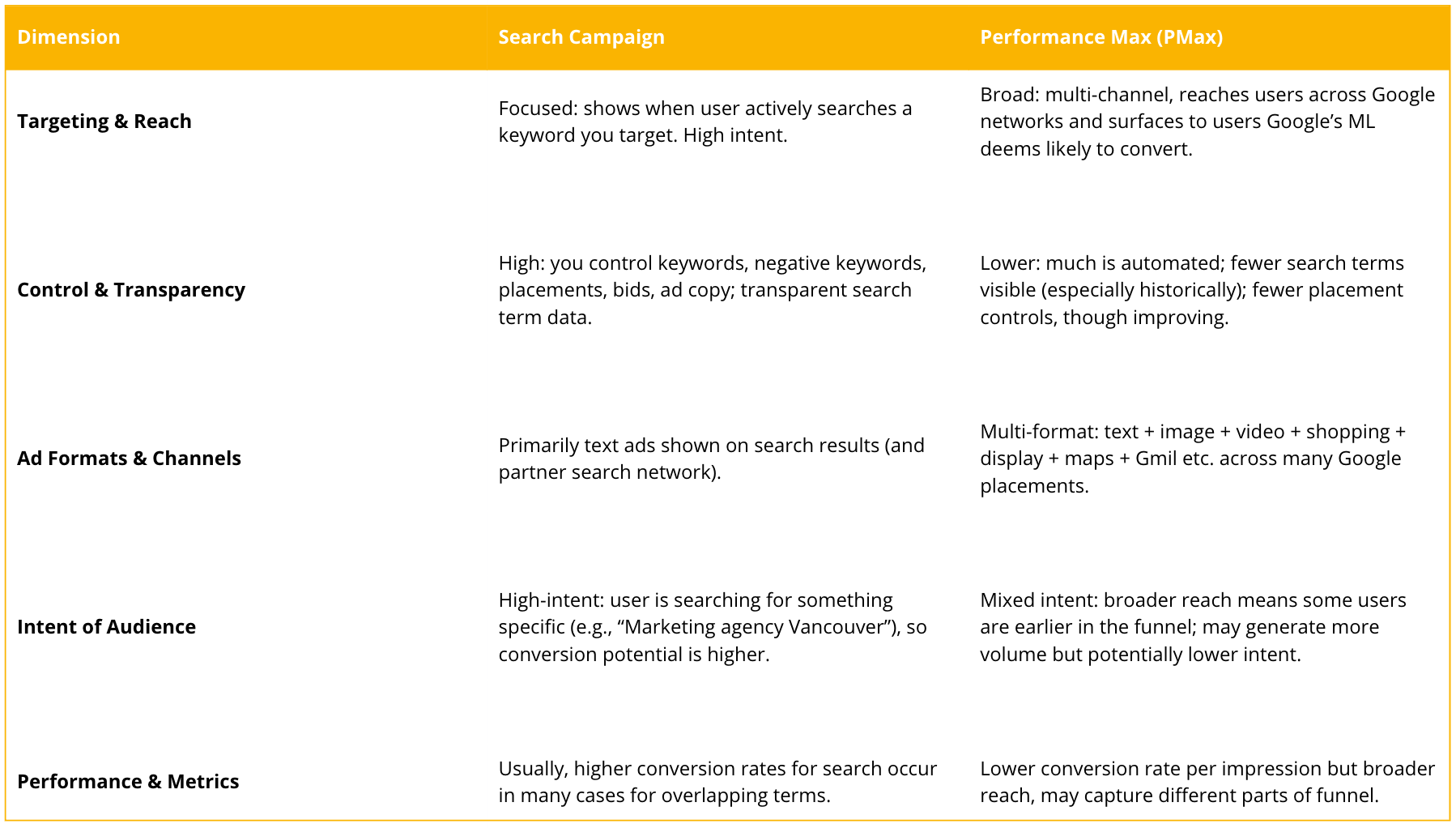
Here is a breakdown of how they differ on important dimensions:
Frequently Asked Questions (and Answers)
Which campaign type converts better?
For high-intent searches (where users are actively looking for what you offer), Search campaigns often outperform PMax in terms of conversion rate and value. Additionally, search campaigns tend to offer strong CTR and fewer invalid clicks.
While PMax may generate more total conversions due to its broad reach, but the quality might be less. Additionally, the Performance Max campaign may tend to offer high invalid clicks and weak CTR and CVR.
Can my PMax cannibalize my Search campaigns?
Yes, there can be overlap if both are targeting the same search terms or keywords/queries. Some advertisers found PMax picking up search traffic that could otherwise be captured by Search campaigns, which could lead to high CPCs. However, there can be different strategies to reduce the risk.
Which campaign should I use when?
Use Search Campaign when: you have well-defined keywords, your search volume is high, you want to be very specific, want full control, your budget is limited, and your main and only focus is quality conversions.
Use PMax campaign when: you want a broad reach across channels, have sufficient budget for machine learning to optimise, you have a limited search volume, you want to test top of the funnel to the bottom of the funnel, you are e-commerce (especially with product feed), and you care about your conversion volume and drive awareness.
In conclusion, both types of campaigns are very powerful and are the most common ads to drive conversions. However, there are several differences between them, and they do not work the same. Therefore, it is recommended to create a clear strategy and ask yourself what your goal is, why you want to run the campaign, what your budget is, and whether you have assets. Continue asking different questions to determine which type of campaign is most suitable for your industry and goals. Furthermore, ensure that you plan ahead for your campaigns and conduct thorough keyword and market research. This will help you identify what campaign might work best for you to maximize your results and offer a healthy performance. If you are new to the digital marketing industry, it is highly recommended to contact a professional for consultation.
