
Google Is Removing Dynamic Search Ads (DSA) For The AI Max
If you're running Google Ads, especially if you rely on Dynamic Search Ads (DSA), Google just announced a change to this campaign type, and whether you're ready or not, this new upgrade will happen in September 2026.
This isn't a minor tweak; it is actually one of the most significant structural shifts in the Google Ads ecosystem this year. Although DSA was a powerful type of campaign, it is true that Google is trying to hard push AI Max. Therefore, if you manage PPC campaigns for your business or your clients, now is the time to understand what's changing, what it means for performance, and how to get ahead of it.
What Are Dynamic Search Ads, and Why Is Google Moving On?
Dynamic Search Ads were introduced back in 2011 as a way for advertisers to discover traffic beyond our regular keyword targeting, capable of offering low CPCs and very relevant search terms at the same time. Instead of targeting specific search terms, DSA campaigns automatically generate headlines and matched ads to relevant queries based on the content of your website or specific landing page. Therefore, it was a great option for businesses with large inventories, complex industries, or low search volume; it was a flexible, low-maintenance solution with positive results.
But search behaviour has changed dramatically, especially with the new AI era. Users are typing longer, more conversational queries as AI-powered features like Google AI Overviews become more prevalent, impacting how marketing agencies optimize SEO or digital ads.
However, as everything evolves, AI Max is the new upgrade of DSA, and marketers or marketing agencies should start adapting and understanding how this works.
What Is Google AI Max for Search?
AI Max for Search is Google's next-generation hub for AI-powered search campaigns. It launched in beta in May 2025, the new Search campaign feature, which we can manually enable or disable. According to Google, marketers and marketing agencies will see this transition completed by the end of September of this year, 2026.
AI Max integrates three main functions into a single system:
Search Term Matching — Goes beyond traditional keywords to identify relevant queries based on broader intent signals.
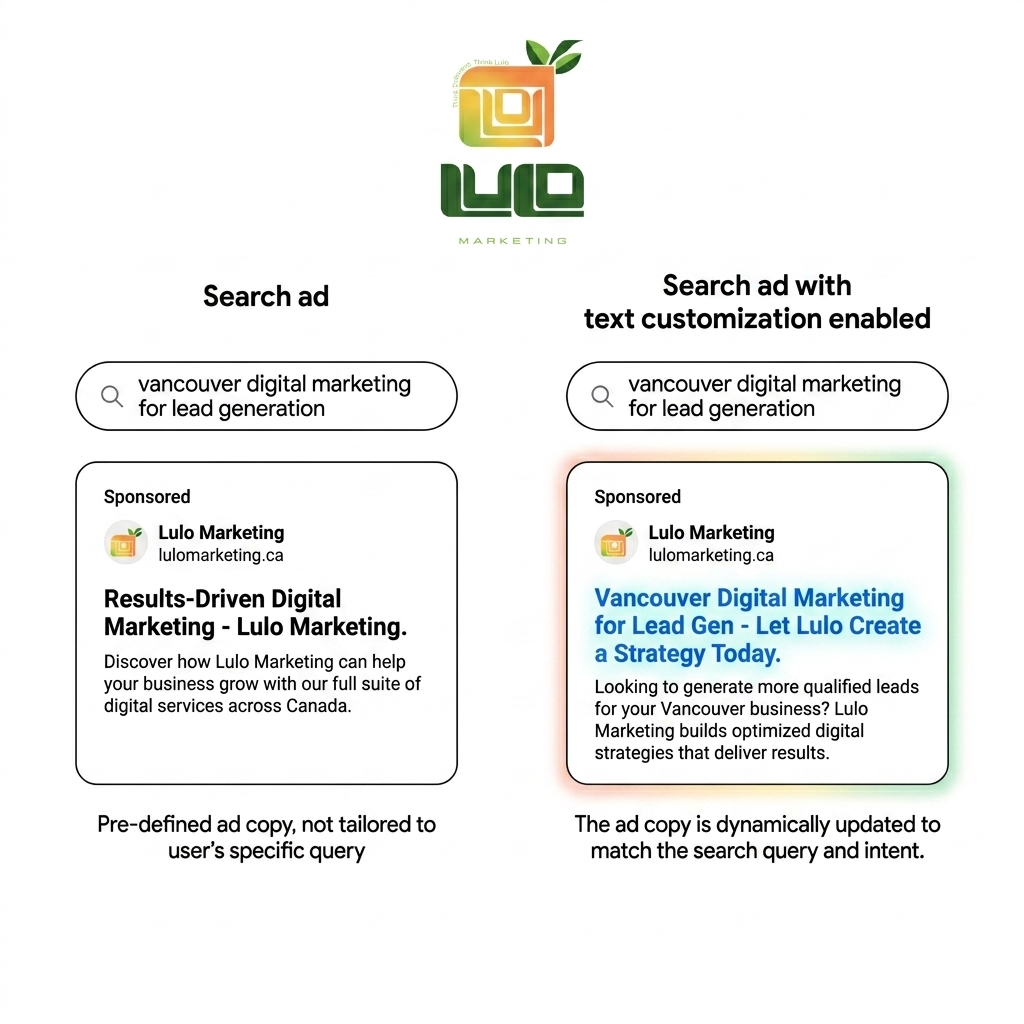
Text Customization — It can automatically adjust ad copy to better align with the specific query being searched for.
Final URL Expansion — It can dynamically route different URLs within the website, potentially aligning the query with the landing page, even if it's not the URL you originally specified.
According to Google, AI Max boosts conversions by an average of 7%, or conversion value. Although many marketers on social media and Reddit have stated that, when AI Max was in beta, they didn’t see value in it.
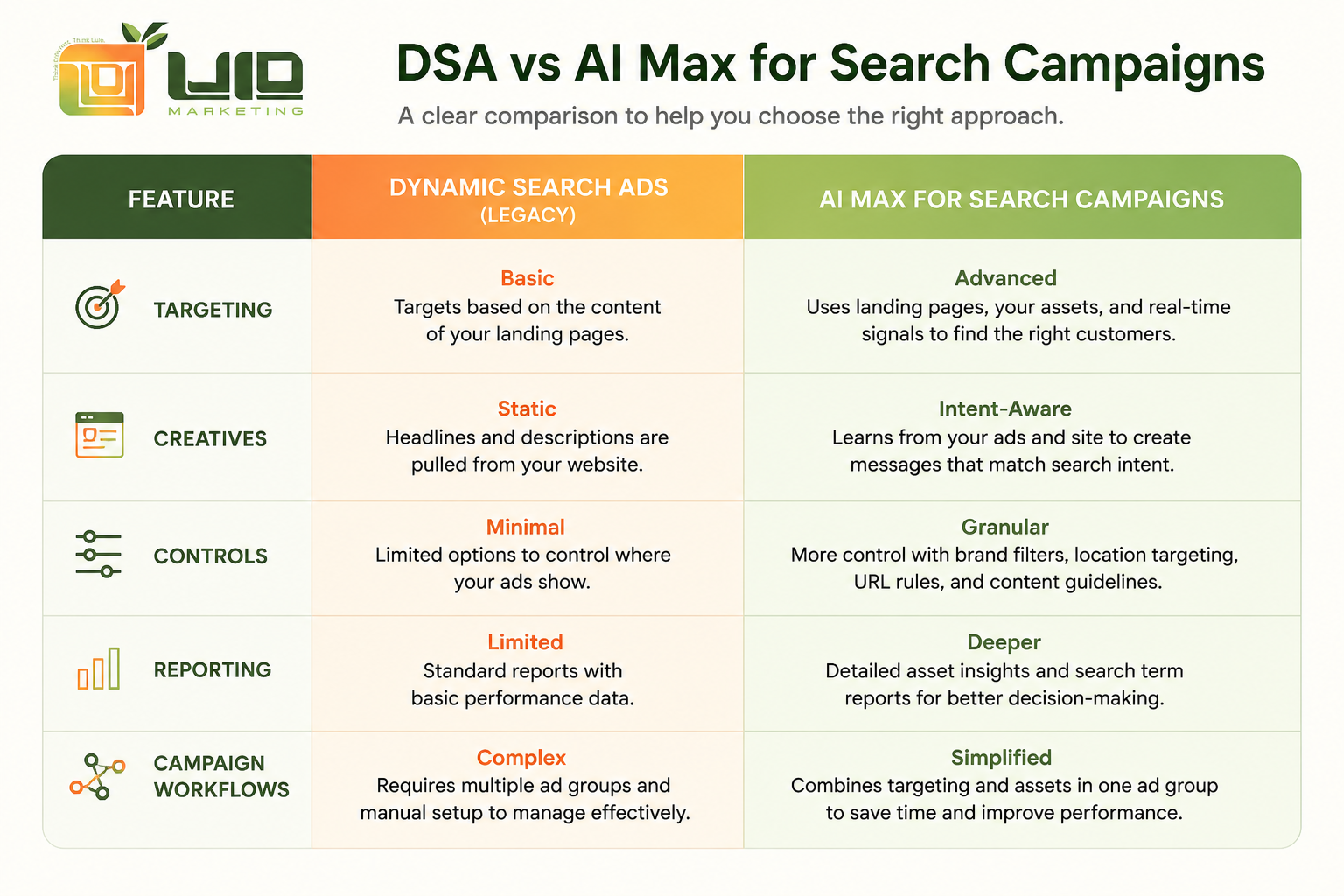
Here is a clear comparison:
How the Transition Is Rolling Out
Advertisers and marketing agencies should see two phases to make the transition smoother by September:
Phase 1: Voluntary or manual migration
DSA advertisers or marketing agencies can now access upgrade tools to manually migrate DSA settings and data into standard ad groups under AI Max. To do this phase, select your campaign, then select settings, and you should be able to manually upgrade the campaign to AI Max.
Phase 2: Automatic Upgrade
Any eligible campaign still running legacy settings will be automatically upgraded to AI Max no later than September 2026. After this period, marketing agencies or marketers will not be able to utilize DSA campaigns.
According to Google, users should receive a 30-day notice before the transition. When the automatic upgrade occurs, Google will configure AI Max settings to make the new ad group as similar as possible to the previous DSA version. That means all three AI Max features (search term matching, text customization, and final URL expansion) will be enabled by default, using information from your website.
What Marketing Agencies or Advertisers Need to Consider
It wouldn't be fair to present this purely as a win. Some early performance data have raised questions worth paying attention to.
While Google cites a 7% conversion uplift, the truth is that AI Max can reach wider audiences, potentially leading to irrelevant search terms and therefore, offering low CVR and ROAS. However, results might vary depending on the types of industries and niches.
For smaller advertisers, marketing agencies, and service-based businesses in particular, it's important to understand how DSA and AI Max work. Although both function similarly, using the available content on the website, the system is predicting user intent rather than matching it directly.
What Marketing Agencies or Marketers Should Do Right Now
Although the AI Max can be unpredictable, here's a practical action plan to smoothly migrate from DSA to AI Max:
Audit your current DSA campaigns: Understand your DSA search term data and flag current irrelevant terms to negate them.
Migrate voluntarily before September: Manual migration lets you configure AI Max settings to better fit your needs, rather than having Google apply default settings that may not align with your goals.
Avoid standard campaign competition with AI Max: Make sure you know all keywords or search themes you are targeting in other campaigns, so you can exclude them from AI Max. Moreover, keep an eye on AI Max search terms to identify keywords, impression share, and traffic to exclude those from standard campaigns.
Track and document: Before the transition, document your key metrics, such as CPA, ROAS, and CVR. So you have a clear benchmark to analyze AI Max outcomes and trends.
Use the new reporting metrics: Google introduced AI Max expanded matches and AI Max expanded landing pages metrics. Utilizing those new features will be crucial to refining AI Max campaigns.
The Bigger Picture
Nowadays, with the rapid development of AI, the PPC industry has also been impacted, and we live in an era where we see almost a new AI feature or update in online advertising. We are gradually transitioning from search terms to signals, with automation handling more of the heavy lifting.
However, keywords are still one of the most important factors in the Google Ads ecosystem. Google has confirmed that even in AI Max, keywords remain a core feature.
